
2026 Finance & Accounting Hiring Outlook for Insurance, Wealth Management, and Financial Services
Hiring in 2026 is less about “more recruiting” and more about operating discipline: clear scope, defensible pay bands, and workflow-ready talent that can perform in AI-enabled finance environments.
The market backdrop is steadier than 2021–2023, but not loose. U.S. hiring is expected to normalize in 2026 with slower job growth and somewhat higher unemployment, not a sharp labor reset.
What this report assumes (2025–2026 evidence)
- The labor market is stabilizing, not surging. Indeed’s U.S. 2026 outlook projects slower hiring momentum and a gradual unemployment increase rather than a cliff event.
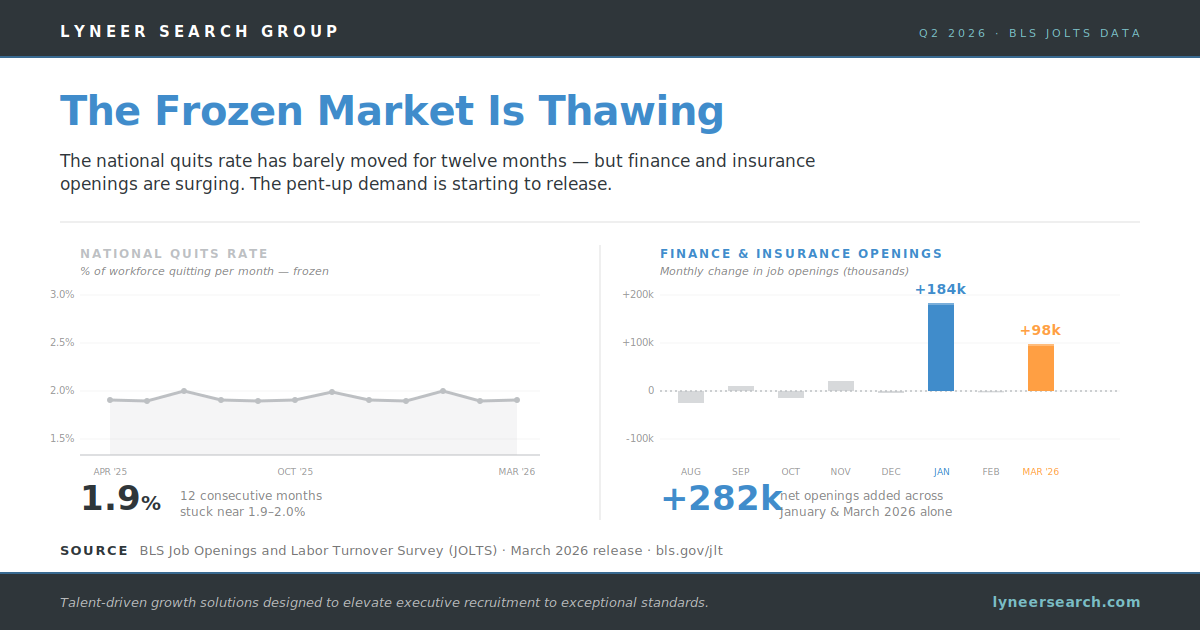
- Churn in finance/insurance remains comparatively low. Finance & Insurance quits were 0.9% in Nov 2025 (NSA; 0.8% in Dec 2025).
- Compensation budgets are normalizing around mid-3%. Mercer reports 3.2% average merit and 3.5% total increase budgets for 2026 in its late-2025 planning survey.
- AI is now a finance operating priority, not an experiment. Deloitte’s Q4 2025 CFO Signals shows 87% of CFOs expect AI to be very/extremely important to finance operations in 2026, and 54% cite integrating AI agents as a transformation priority.
Build a 2026 compensation plan that won’t trigger churn.
Access our latest salary and hiring benchmarks, then we’ll help you calibrate role scope and ranges for your market.
The hiring advantage in 2026 goes to firms that
- Define scope tightly (what outcomes the role owns, what it doesn’t)
- Hire for skills + systems + judgment (not just “years”)
- Run structured interviews that test real execution
- Build pay bands around scarcity and role design, not legacy titles
What changed since 2025
1) Skills disruption is still high—more stable, and now measurable in hiring criteria
WEF reports employers expect 39% of workers’ core skills to change by 2030 (down from 44% in 2023, but still substantial). In finance hiring, that supports explicit screening for process modernization capability, not just transaction processing experience.
2) AI isn’t removing finance talent demand—it’s redefining top-tier talent
PwC’s 2025 AI Jobs Barometer finds wages rising faster in AI-exposed industries and reports a significant premium for AI-skilled workers (56% in its 2025 reporting).
Practical implication: premium value is shifting to operators who can apply AI in controlled workflows (reconciliation design, forecasting, variance diagnostics, narrative reporting, controls evidence).
3) The accounting pipeline is still constrained, despite early positive signals
AICPA/Journal of Accountancy reporting shows 55,152 accounting bachelor’s/master’s degrees in 2023–2024 (-6.6% YoY), while Spring 2025 accounting enrollment rose to 266,506 (+12.4% YoY). CPA candidate flow also remains volatile (28,082 new candidates in 2024; 16,448 in the first six months of 2025). Net effect for employers: near-term experienced-talent scarcity persists.
A visible market response has been expansion of India-based accounting delivery capacity by U.S. firms to offset domestic shortages.
4) Compensation planning is stabilizing, but scarcity pricing persists
BLS ECI (12 months ending Sept 2025) shows wages/salaries +3.6% YoY and private-industry compensation costs +3.5% YoY, consistent with 2026 salary budget planning in the mid-3% range. Average budgets are stable; scarcity roles still clear above average.
5) Candidate motivators: flexibility matters, but so do stability and development
SHRM’s 2025 benefits data places flexible work (68%) and professional/career development (65%) among top-priority benefit categories. Gallup also shows work-location patterns have been relatively stable since 2022, and only 23% of remote-capable Gen Z workers prefer fully remote work.
Winning offers in 2026 combine clarity, growth path, manager quality, and practical flexibility.
Teams most impacted and what to hire for
Controllership
Hire for: close acceleration with clean reconciliations; SOX/ICFR control mindset; ERP/consolidation/workflow fluency; plain-English variance communication.
Caution signals: task-only narratives; weak control-evidence ownership; limited root-cause analysis.
FP&A
Hire for: driver-based modeling, scenario discipline, assumption governance, executive storytelling.
Caution signals: dashboard production without decision influence; tool fluency without business mechanics.
Statutory Accounting
Hire for: NAIC/SSAP fluency, schedule ownership, actuarial/reinsurance partnering, deadline precision.
Caution signals: GAAP-vs-statutory confusion; reviewer-only background with no filing ownership.
Tax
Hire for: multi-entity/multi-state review depth, proactive planning, clean cross-functional documentation.
Caution signals: pure compliance posture, weak advisory communication, poor peak-cycle project control.
Treasury
Hire for: cash forecasting rigor, liquidity planning, counterparty/risk awareness, policy discipline.
Caution signals: no stress-testing framework; “bank-portal operator” mindset.
Hiring playbooks by company type
Insurance carriers
AI adoption is increasingly embedded across underwriting, claims, fraud detection, and risk management; finance hiring should reflect higher control and evidence standards.
Playbook
- Define statutory vs GAAP vs management-reporting boundaries in intake.
- Use regulatory-readiness work samples (mini schedule/footnote + issue spotting).
- Price for controls depth and audit/exam reliability, not generic title equivalence.
Brokers/agencies
Playbook
- Prioritize integration/reporting talent where M&A is active.
- Test speed + operational discipline (close cadence, commission/accounting coordination).
- Use timed case prompts for judgment under pressure.
Asset managers / retirement platforms
Playbook
- Test “messy data → decision memo” capability.
- Maintain high controls/accuracy standards (client trust sensitivity).
- Require cross-functional fluency with investments, ops, and client teams.
Multi-family offices / UHNW platforms
Playbook
- Hire for multi-entity complexity (trusts, alternatives, cash movement, reporting).
- Test documentation quality and client-ready communication.
- Prioritize calm execution and high-trust stakeholder behavior.
Interview scorecards (recommended)
Use a 100-point model:
- Technical mastery (25): role fundamentals + error detection
- Systems/process (20): workflow design + automation orientation
- Judgment/risk (20): controls, issue spotting, escalation instincts
- Business partnership (20): influence, clarity, stakeholder management
- Leadership behaviors (15): ownership, coaching, pace, integrity
Work-sample prompts
- Controller: reconcile accounts, surface risk, propose close redesign.
- FP&A: build driver model and deliver 1-page executive readout.
- Statutory: map fact pattern to statutory vs GAAP outcomes and deadlines.
- Tax: lay out scenario response, stakeholders, and documentation trail.
- Treasury: produce forecast, stress assumptions, define policy controls.
Compensation planning ranges (2026)
Anchor decisions to three layers:
Layer 1: External demand guardrails
BLS projects about 124,200 accountant/auditor openings per year over the decade (driven heavily by replacement demand). Use as labor-pressure context, not title pricing.
Layer 2: 2026 movement assumptions
Use
~3.2% merit / ~3.5% total as baseline planning assumptions, then target above-baseline allocation to scarcity roles.
Layer 3: Role-level market anchors (Lyneer 2025 Insurance Salary Guide)
| Role | 25th | Median | 75th | 90th |
|---|---|---|---|---|
| Chief Financial Officer (CFO) | $175,000 | $250,000 | $325,000 | $400,000 |
| Controller | $135,000 | $165,000 | $195,000 | $225,000 |
| Statutory Reporting Manager | $120,000 | $140,000 | $160,000 | $180,000 |
| FP&A Director | $150,000 | $175,000 | $200,000 | $225,000 |
| Treasurer | $150,000 | $175,000 | $200,000 | $225,000 |
| Tax Director | $135,000 | $155,000 | $175,000 | $200,000 |
| Senior Accountant | $85,000 | $95,000 | $110,000 | $125,000 |
| Financial Analyst | $75,000 | $88,000 | $100,000 | $115,000 |
| Treasury Analyst | $80,000 | $95,000 | $110,000 | $125,000 |
Source: Lyneer 2025 Insurance Salary Guide.
Total-comp context (same guide): CFO packages commonly include bonus/LTIP/stock; Controller/Finance Director roles often include performance bonus; FP&A/Treasury/Senior Accountant roles typically include modest bonus opportunities.
How to avoid churn in 2026
- Publish a clear leveling framework (Manager vs Sr. Manager vs Director scope).
- Budget for compression corrections before offer stage.
- Decide whether the role is a builder (process redesign) or caretaker (steady-state operation) and price accordingly.
- Keep flexibility policies operationally fair and team-coordination ready.
- Align manager quality, growth path, and role clarity in the offer narrative.
5 Lyneer insights for faster-close searches in 2026
- Tight scope at intake (no stealth requirement expansion mid-search).
- One critical skill cluster per search, not five.
- Work-sample interviews to reduce false positives.
- Compensation bands built on scarcity and mandate complexity.
- A credible 6–12 month career story that candidates can say “yes” to.
Want our finance & accounting interview scorecards?
We’ll share role-specific scorecards (Controller, FP&A, Statutory, Tax, Treasury) and a work-sample template you can deploy in your next hiring cycle.
Frequently Asked Questions
What’s the single biggest hiring change for finance/accounting in 2026?
Hiring managers are moving from “years of experience” toward skills + judgment + systems—because core skills disruption remains high and AI-enabled workflows are now table stakes.
Are wages still rising meaningfully in 2026?
Overall budgets look steadier (around mid-3% planning), but pay is being allocated more selectively—especially for starting salaries and critical skill groups.
How do I budget a salary range without relying on a generic “salary guide” number?
Anchor to reputable baselines (BLS medians/percentiles), then adjust for (1) industry premium, (2) geography, and (3) scarcity skills (statutory + systems + leadership).
Why do statutory accounting roles take longer to fill?
They combine domain specificity (NAIC/SSAP) with deadline pressure and low tolerance for errors—plus the broader accounting pipeline constraint.
What interview format best predicts performance for Controllers and Statutory leaders?
A structured scorecard plus a short work sample (recon + risk spotting + narrative) consistently outperforms unstructured interviews for predicting execution quality.
How should we test AI readiness without turning the interview into a tech quiz?
Test applied judgment: “How would you use AI to accelerate variance commentary without leaking sensitive data or making unsupported claims?” The goal is workflow maturity, not prompts.
We’re seeing lots of applicants—why does it still feel hard?
High application volume often increases screening noise; many teams report it’s harder to identify truly qualified candidates even with more inbound.
What’s the most common reason finance hires churn in the first year?
Mismatch between promised scope and actual scope (especially around close intensity, stakeholder load, and modernization expectations).
Fix this with an intake doc + scorecard.
How do wealth management talent shortages affect finance/accounting hiring?
When advisor capacity is constrained, firms prioritize productivity and operating model changes—creating additional demand for finance/ops talent who can standardize, automate, and support scalable service.
What should we do first if we need to hire 3+ finance/accounting roles this year?
Run a 30-minute “role calibration” across leaders: scope, leveling, must-have skill cluster, interview plan, and compensation band. Then sequence hires based on risk to reporting deadlines and cash/controls.
Talk to an search consultant.
Hiring in 2026? Let’s pressure-test your plan in 15 minutes.
We’ll validate scope, compensation banding, and interview design—then tell you what it will take to land talent in today’s market.