




Bridging Generations in Insurance and Wealth Management: A 2026 Hiring Guide for Talent Leaders
July 3, 2025
How talent leaders across insurance and wealth management build teams that hold onto what the retiring generation knows, while bringing in the one that's coming next.
Five generations now share the same office. The underwriter who priced your book through three hard markets sits a few desks from an analyst who has never filed a paper form. The advisor with a 30-year client roster works down the hall from the planner who runs the whole relationship from a phone. That mix only becomes a problem when you hire and manage as if everyone wants the same things.
For talent leaders in insurance and wealth management, the math got serious this year. The U.S. Chamber of Commerce estimates the insurance industry will shed about 400,000 workers to retirement by the end of 2026, and less than 25% of the current insurance workforce is under 35. The knowledge walking out the door, underwriting judgment, reserving logic, regulator relationships, client trust built over a full market cycle, doesn't move through a two-week handoff.
So the question sitting on every hiring leader's desk is a practical one. How do you keep what your senior people know while building a bench the next generation actually wants to join?
Who's on your team right now
By the second quarter of 2024, the U.S. labor force broke down roughly like this, according to Bureau of Labor Statistics data analyzed by the Department of Labor:
- Millennials: 36%, the largest single share
- Gen X: 31%
- Gen Z: 18%, having passed Baby Boomers in late 2023
- Baby Boomers: 15%
- Silent Generation: about 1%
Teams inside insurance and wealth firms skew older than that national picture, which is exactly why the retirement wave lands hard. Your Boomer underwriters, claims leaders, and senior advisors and your Gen X actuaries, controllers, and compliance heads hold the relationships and the judgment. Your Millennial and Gen Z hires hold the tooling fluency. Both halves carry weight.
What each generation actually brings
Skip the personality stereotypes. Name the work.
Boomers and older Gen X hold underwriting, actuarial, and advisory judgment that took decades to build, plus the regulator relationships and the instinct for a market cycle you can't teach in onboarding.
Gen X runs the operating backbone across functions. They own the close, the reserving, the claims operation, the compliance program, and the client books that keep a wealth practice steady.
Millennials are the rising leaders now. They're rebuilding client reporting, pulling analytics into underwriting and FP&A, and reshaping how advisors run a relationship.
Gen Z arrives fluent in the tools. Deloitte's 2026 survey of more than 22,500 Gen Z and millennial respondents across 44 countries found 74% already use AI in their day-to-day work and treat it as an accelerant rather than a threat.
As Lyneer Senior Client Partner Vince Crochunis puts it: "When it comes to finance, generational balance creates both operational reliability and future-readiness."
Five things that actually work
1. Write each role to a real person.
A 58-year-old chief underwriter and a 26-year-old analyst read the same job post differently. The senior candidate wants scope and a clear seat in the leadership structure. The younger one wants to know the tools are modern and the firm will pay for the designation exams. Say both. A generic post says nothing to either.
2. Put knowledge transfer on someone's goals.
Pair the retiring chief underwriter, chief actuary, or senior advisor with the person who'll inherit the book, and write it into both their reviews. The transfer runs in two directions. The senior hand passes down the judgment; the younger one shows where automation removes three days of manual work. Firms that leave this to chance lose the institutional knowledge the U.S. Chamber of Commerce keeps warning about.
3. Treat flexibility as a retention tool, because it is.
A 2026 national workforce study puts professional and financial services among the fields where hybrid arrangements are most common, and 47% of professionals who aren't actively job-hunting say keeping their current flexibility is a reason they stay. That holds across ages. Your Gen X controller with two kids in high school values a compressed week as much as the 28-year-old does.
4. Fund the credential.
CPA, CFA, FCAS, FSA, CPCU, CFP. The exam fees and study time are small next to the cost of a counteroffer. Deloitte's 2026 survey found 55% of Gen Z and 52% of millennials are delaying major life decisions over money. Cover the path to the credential and you buy loyalty cheaper than a raise.
5. Fix the image problem before it costs you the pipeline.
Younger talent doesn't picture itself in insurance. The Hartford's research, cited by the Insurance Information Institute, found just 4% of millennials want to work in the industry, with "boring" and "selling insurance" doing most of the damage. You change that one analyst at a time, by showing the actual work: pricing a new specialty line, building the reserving model, sitting in on a reinsurance renewal. The work is interesting. The recruiting hasn't kept up.
What this means for your next hire
In high-trust insurance and wealth roles, a generational range is how you keep underwriting sharp, compliance clean, and client relationships intact while the workforce turns over underneath you. The firms that win the next five years will put their most experienced people and their newest ones in the same room, and build the handoff on purpose.
As Scott Noga of Lyneer Search Group notes: "Finance leaders have to look past the resume and into generational strengths. That's where lasting performance and culture come from."
How Lyneer approaches it
We've placed leaders across underwriting, actuarial, finance, operations, compliance, and advisory roles in insurance, wealth management, and financial services since 1993, with a 100% placement rate on every retained search and 90% of those placements earning promotions inside their organizations.
The Lyneer Executive Search Strategy™ evaluates every candidate on four things against your specific role: technical skill, leadership capability, cultural alignment, and long-term growth potential. For a multigenerational team, that last one carries the most weight. We look for the chief underwriter, actuary, CCO, controller, or advisor who fits where your firm is headed.
If you're building a finance team that has to span a retirement wave and a hiring market that's tighter than it looks,
let's talk.

A specialty insurance carrier needed a VP of Claims with property claims experience, based in Tampa. We presented 4 candidates and the client interviewed 3. 2 were solid, and the third was on the verge of an offer. Then senior company leadership stepped in.

How to hire a statutory accounting leader who can run an NAIC-ready close. Role calibration, interview framework, comp benchmarks, and red flags to screen out.

Insurance unemployment is 1.4% and 43% of carriers are holding headcount. Here's why your toughest Q2 2026 hires need more than standard recruiting.

CIO total compensation hit $1.82M. Three new roles emerged. Discover what's driving compensation growth across family offices and MFOs in 2026 — and download the full benchmark guide.
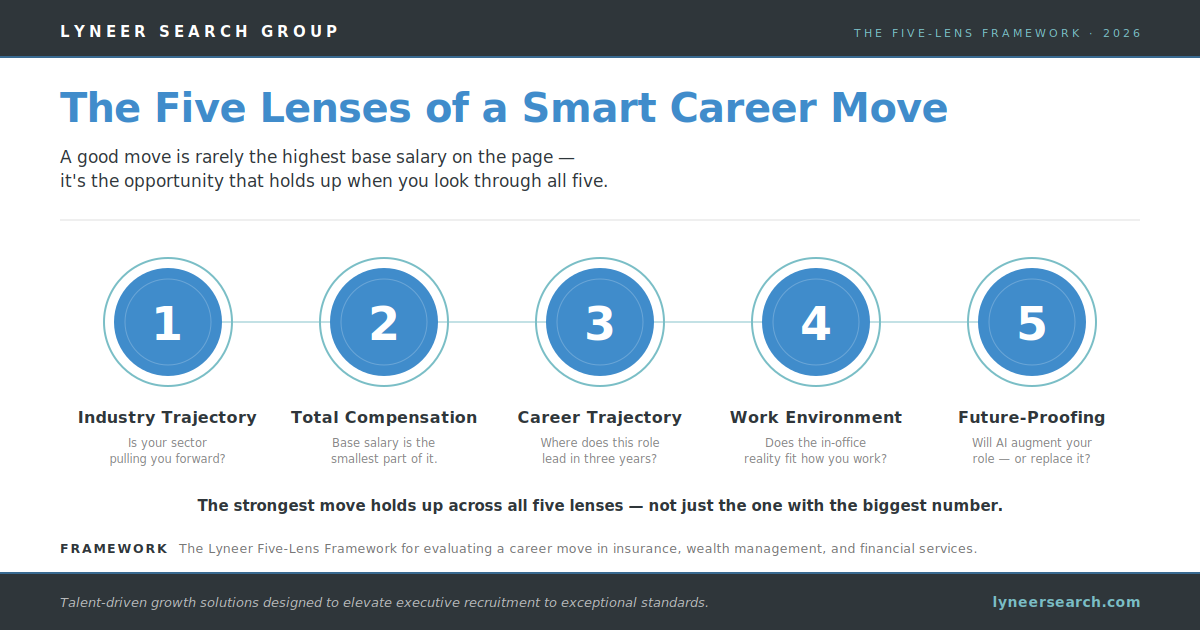
Base salary is rarely the right call. The five lenses that actually determine a good career move in insurance, wealth management, and financial services.
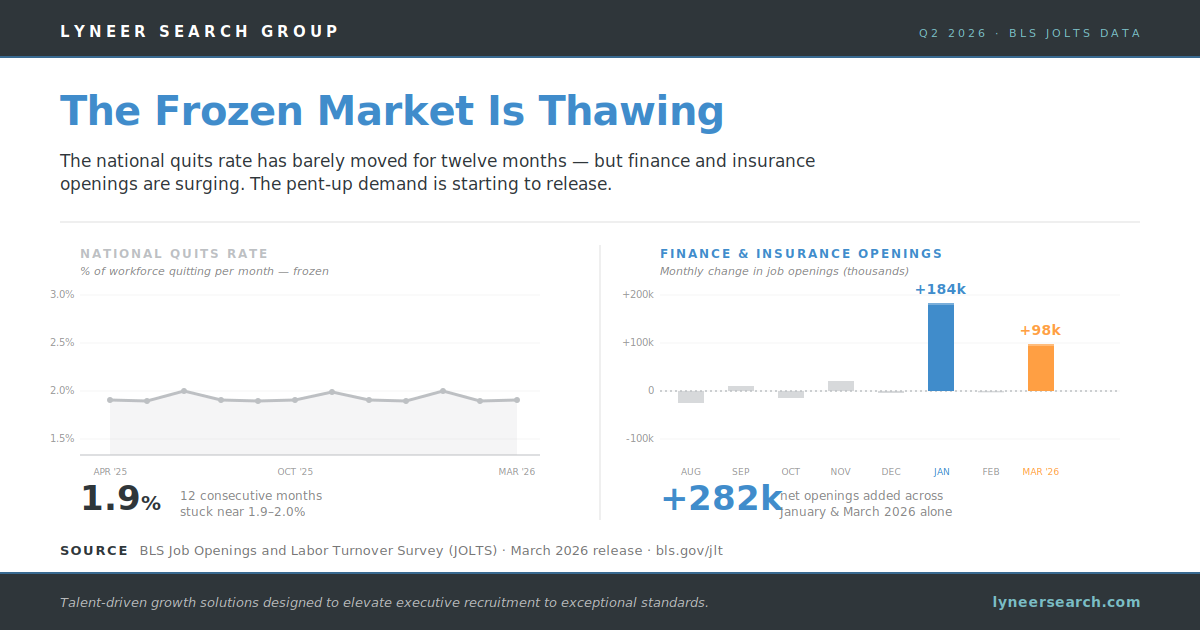
After two-plus years frozen, the job market is thawing. Finance & insurance openings are surging — here's what it means for candidates and hiring managers.

The insurance industry is losing 400,000 workers while five new roles emerge. Specialty underwriters earn 25–50% more than generalists. Download Lyneer's 2026 Insurance Salary Guide covering 80+ roles across carriers, brokers, and MGAs.

If you lead a wealth management practice, you have likely spent the last year hearing some version of the same message: hiring experienced advisors and planners has never been harder. Talent is scarce, competition is fierce, and the candidates you want are not looking.

If you lead talent strategy at an insurance carrier, you are navigating one of the most deceptive hiring markets in recent memory.

International Women's Day 2026 them Give to Gain is a springboard for leadership among industry leaders. Lyneer Search Group Celebrate's their voices and highlights their impact.