




Three Forces Are Converging on Wealth Management Hiring in Q2 2026
April 7, 2026
If you lead a wealth management practice, you have likely spent the last year hearing some version of the same message: hiring experienced advisors and planners has never been harder. Talent is scarce, competition is fierce, and the candidates you want are not looking.
That assessment is correct. But it understates the situation.
What is actually happening in Q2 2026 is not a single hiring challenge. It is the convergence of three structural forces — any one of which would strain your talent strategy. Together, they are creating the most competitive senior hiring environment the wealth management industry has seen in decades.
1. The Largest Wealth Transfer in History Is Accelerating
The numbers have been revised upward, and they are staggering.
Cerulli Associates' most recent projections estimate that approximately $124 trillion in wealth will change hands by 2048 — substantially higher than earlier estimates of $84 trillion, driven by asset price appreciation, inflation adjustments, and the growing concentration of wealth among older households. Nearly $100 trillion of this total is expected to originate from Baby Boomers and older generations.
This is not an event on the horizon. It is happening now. Gen X stands to inherit approximately $14 trillion over the next decade, according to Cerulli, while Millennials are projected to receive roughly $46 trillion over the longer horizon.
For wealth management firms, this transfer represents both the largest growth opportunity and the largest retention risk of a generation. Cerulli's research indicates that more than 70 percent of heirs are likely to change financial advisors after inheriting their parents' wealth. The firms that retain and grow these relationships will be the ones with advisors who can navigate complex multigenerational conversations — professionals who blend deep technical planning knowledge with the emotional intelligence that family wealth transitions require.
These professionals do not grow on trees. They are developed over 10, 15, or 20 years of client-facing practice. And right now, they are in extraordinarily short supply.
2. The 2026 Estate Tax Inflection
Adding immediate urgency to the wealth transfer dynamic, 2026 has brought a significant shift in the federal estate and gift tax landscape. The lifetime gift and estate tax exemption has settled at $15 million per individual and $30 million per married couple. The annual exclusion stands at $19,000 per recipient.
This creates a wave of client demand for sophisticated estate planning — trust structures, lifetime gifting strategies, generation-skipping transfer planning, and coordinated multi-entity wealth plans. High-net-worth and ultra-high-net-worth clients are actively seeking strategic guidance, and they expect their advisors to deliver it with technical precision.
The firms that have senior practitioners with deep trust, estate, and tax strategy expertise are capturing this demand. The firms that do not are watching clients move to competitors who can provide the planning depth they need.
This is not a temporary spike. The combination of accelerating wealth transfers and the evolving tax landscape means that demand for advanced planning expertise will remain elevated for years. The question for hiring managers is whether you are staffing for this reality now or hoping to catch up later.
3. The Structural Advisor Shortage
While the first two forces are driving demand for senior wealth management talent upward, the third force is constraining the supply.
McKinsey estimates that approximately 110,000 financial advisors — equivalent to 38 percent of the current workforce — will retire by 2034. To meet growing client demand, the firm projects the industry will need between 30,000 and 80,000 net new advisors over the next decade. For context, the industry added only 8,000 net new advisors in the previous ten years.
This is a structural deficit that cannot be solved by any single firm's recruiting effort. The math is straightforward: the number of experienced advisors leaving the industry is dramatically outpacing the number entering it, and the entering cohort requires years of development before they can handle the complexity that high-net-worth clients demand.
The advisor shortage is not limited to wealth management alone. The broader insurance and financial services industry is experiencing the same dynamic. The most recent semi-annual U.S. insurance labor market study found that 43 percent of insurance carriers plan to maintain current staff levels — a 15-year high — reflecting an industry-wide pivot toward retention over expansion. The roles that do open are concentrated at the senior level, creating intense competition for the same experienced professionals you are trying to recruit.
AI Is an Amplifier, Not a Replacement
Some hiring managers are asking whether artificial intelligence might ease the talent pressure — whether technology can substitute for the advisors they cannot find.
A recent industry survey found that more than two-thirds of wealth management firms are already using generative AI within their operations, with applications ranging from client communication drafting to portfolio analysis and research. AI is genuinely improving advisor productivity.
But AI is augmenting experienced advisors, not replacing them. The elements of wealth management that clients value most — the judgment call on a complex estate structure, the empathy in navigating a family's divergent financial priorities, the strategic thinking that balances tax efficiency with a client's deeply personal goals — these remain fundamentally human competencies.
What AI is doing, however, is raising the bar for what an experienced advisor can accomplish. Advisors who can leverage AI tools to enhance their practice are more productive and more valuable. And this means the gap between a strong senior hire and an adequate one has widened. The right hire — a seasoned practitioner who combines technical depth, relationship skill, and technological fluency — delivers disproportionate value in 2026.
The Window Is Now
Here is what the convergence of these three forces means in practical terms for your Q2 hiring decisions.
The demand for senior wealth management talent — particularly in trust, estate planning, tax strategy, and complex financial planning — is being driven by structural forces that will not ease. The supply of that talent is constrained by demographic realities that will take years to correct. And every quarter you wait to fill a critical seat is a quarter where client demand goes unmet, relationships are at risk, and competitors with deeper benches are capturing market share.
The candidates who can solve these problems are not on job boards. They are performing well in their current roles, often at firms that are working hard to retain them. Reaching these professionals requires a confidential, relationship-driven search approach — one built on deep knowledge of the wealth management industry and years of trust with the professionals who work in it.
At Lyneer Search Group, we have spent more than 25 years operating exclusively at the intersection of executive talent and the insurance, financial services, and wealth management industries. We maintain a 100 percent placement rate in retained searches since 1993. Ninety percent of our placements earn promotions within their organizations. And in 2025, we were recognized among America's Top 250 Executive Search Firms.
We understand the wealth management hiring landscape because we have operated in it for three decades.
Our full analysis of Q2 2026 — including insurance and wealth management data, the complete retirement and AI impact assessment, and verified source citations — is available in our new report: The Strategic Hire: Q2 2026 Hiring Perspective for Insurance & Wealth Management.
If you are navigating a senior hire in wealth management this quarter, let's have the conversation. Our search consultants can provide a confidential assessment of your talent needs and discuss how our deep industry network can accelerate your search.
Lyneer Search Group specializes in executive recruitment for roles in insurance, financial services, and wealth management.
Let's Talk Talent

How to hire a statutory accounting leader who can run an NAIC-ready close. Role calibration, interview framework, comp benchmarks, and red flags to screen out.

Insurance unemployment is 1.4% and 43% of carriers are holding headcount. Here's why your toughest Q2 2026 hires need more than standard recruiting.

CIO total compensation hit $1.82M. Three new roles emerged. Discover what's driving compensation growth across family offices and MFOs in 2026 — and download the full benchmark guide.
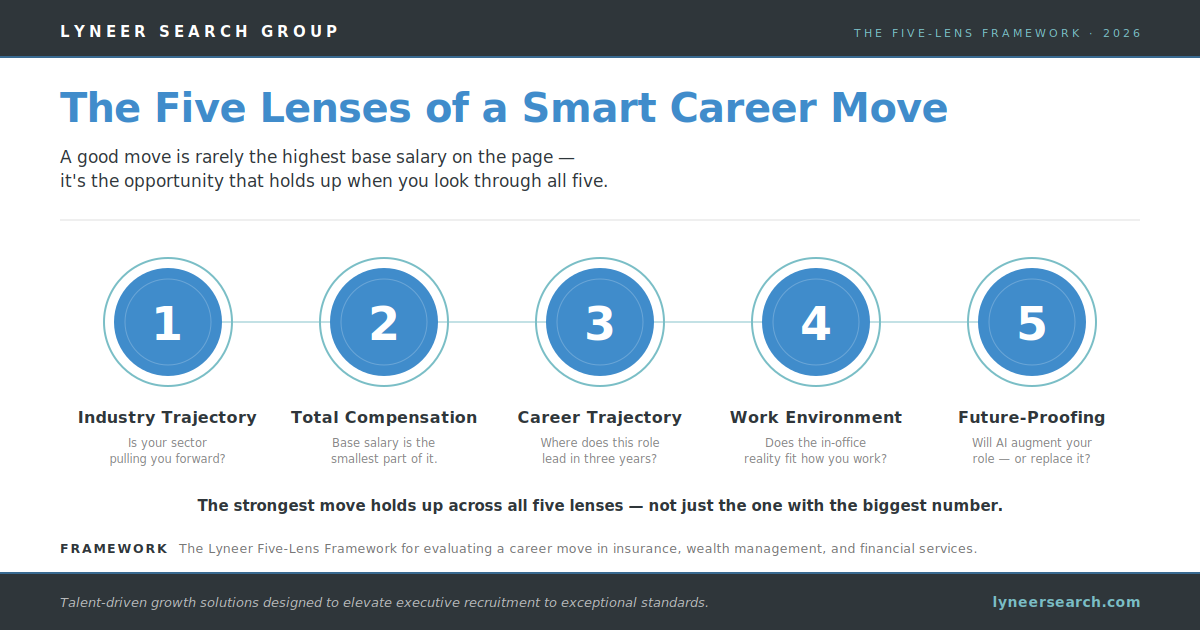
Base salary is rarely the right call. The five lenses that actually determine a good career move in insurance, wealth management, and financial services.
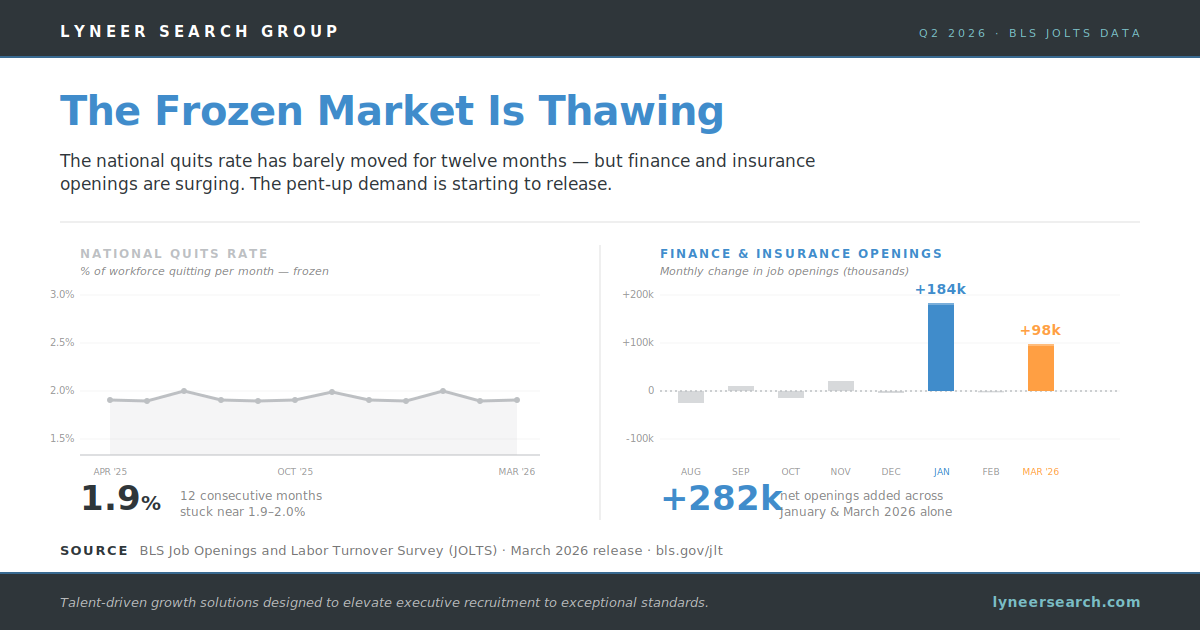
After two-plus years frozen, the job market is thawing. Finance & insurance openings are surging — here's what it means for candidates and hiring managers.

The insurance industry is losing 400,000 workers while five new roles emerge. Specialty underwriters earn 25–50% more than generalists. Download Lyneer's 2026 Insurance Salary Guide covering 80+ roles across carriers, brokers, and MGAs.

If you lead talent strategy at an insurance carrier, you are navigating one of the most deceptive hiring markets in recent memory.

International Women's Day 2026 them Give to Gain is a springboard for leadership among industry leaders. Lyneer Search Group Celebrate's their voices and highlights their impact.

Discover how the insurance, wealth management, MFO/ UHNW, financial services industries are evolving as 2026 is changing the game. Gain expert hiring tips and industry insights to navigate 2026 with confidence.

Discover why working with Lyneer Search Group helps middle market insurers expand faster and smarter—accessing top executive talent, reducing risk, and saving time.