




Insurance Compensation Is Splitting in Two — Here's What the 2026 Data Reveals
April 21, 2026
If you're setting compensation at a carrier, staffing a growing MGA, or trying to retain your best underwriters and actuaries, the 2026 insurance market has a clear message: generalist pay and specialist pay are no longer on the same curve.
Lyneer Search Group's 2026 Insurance Industry Salary Guide — covering 80+ roles across nine functional areas, with separate benchmarks for carriers, brokers, and MGAs — reveals an industry where talent scarcity, specialty complexity, and digital transformation are reshaping what it costs to hire and keep the people who matter most.
Here are three findings you need to know.
1. The 400,000-Worker Talent Crisis Is No Longer a Projection — It's Happening
The Bureau of Labor Statistics projected the insurance industry would lose approximately 400,000 workers through attrition by 2026. That number is no longer a forecast. It is the operating environment.
Roughly 50% of the current insurance workforce is projected to retire by 2028. The industry maintains a 1.6% unemployment rate — less than half the national average — making it one of the tightest labor markets in all of financial services.
The result is sustained upward pressure on compensation across every function. The leading annual agency salary survey (February 2026, ~500 respondents) found agency owners and management reported a 16.8% total income increase for 2025, following a 17.9% increase the year before. Producers and sales professionals saw a 5% jump in total compensation. These are not one-year anomalies. They are structural.
The hardest roles to fill right now — experienced commercial lines account managers, specialty underwriters, and actuaries with data science skills — take 12 to 20 weeks on average to fill. Firms that start sourcing when a seat opens are already behind.
2. Specialty Lines Have Become the Compensation Engine
The most consequential compensation trend in 2026 is the widening gap between generalist and specialist pay.
Underwriters and brokers focused on E&S, cyber, climate risk, and specialty casualty now earn 25–50% more than their generalist peers at comparable experience levels. A standard commercial underwriter earns a median base of $88,000. An E&S or specialty underwriter earns $122,000. A cyber risk underwriter — one of five new roles identified in this year's guide — commands $130,000 at median, with the 90th percentile reaching $182,000.
The same pattern holds in actuarial. The industry-standard actuarial salary survey confirms that actuaries who combine traditional credentials with proficiency in Python, R, and SQL earn 10–15% more at every experience level than peers in traditional modeling roles. P&C actuaries continue to lead in both base salary and bonus at every credential level, and mid-career FCAS actuaries in consulting now earn median total compensation of $210,000–$240,000.
This isn't a temporary hard-market premium. As loss costs, litigation trends, and social inflation increase the complexity of specialty and emerging-risk lines, the value — and the price — of expertise in those areas will continue to separate from the generalist baseline.
3. Five Roles Emerged That Didn't Exist in Last Year's Guide
The talent needs of the insurance industry are evolving faster than most compensation plans account for.
Five roles appear in this year's guide for the first time:
- IFRS-17 Implementation Specialist ($135,000–$210,000 base) — Life carriers and reinsurers navigating global reporting convergence need specialized talent that sits at the intersection of actuarial, accounting, and systems implementation.
- AI & Algorithmic Risk Analyst ($118,000–$192,000 base) — State-level AI regulations, including Colorado SB 205 and NYC Local Law 144, now create formal obligations for insurers using AI in underwriting, pricing, or claims decisions. Someone needs to audit those models for bias and ensure compliance. This role didn't have a title three years ago. Now it commands nearly $200K at the top of the range.
- Cyber Risk Underwriter ($105,000–$182,000 base) — Demand for cyber underwriting expertise continues to outpace supply as policy complexity and premium volume grow simultaneously.
- Climate / Parametric Underwriter ($108,000–$190,000 base) — Insurers developing products around climate exposure, carbon risk, and parametric triggers are building underwriting teams for product categories that barely existed five years ago.
- Fraud Intelligence Analyst ($88,000–$148,000 base) — The growing use of AI-driven fraud detection in claims requires domain experts who bridge claims knowledge with data analytics and pattern recognition.
The Full Picture
These three data points are a starting place.
Lyneer's complete 2026 Insurance Industry Salary Guide covers:
- 80+ roles across nine functional areas: Accounting, Finance, Risk & Compliance, Actuarial, Underwriting, Claims, Sales & Distribution, Technology & Data, and Operations
- Segment-specific salary tables — separate benchmarks for carriers, brokers, and MGAs where compensation structures diverge materially
- 25th, 50th, 75th, and 90th percentile breakdowns for every role
- Regional salary data for New York, California, Chicago/Hartford, Florida, Texas, Baltimore/D.C., and Seattle — plus remote/distributed benchmarks
- Total compensation and incentive frameworks by level, from C-suite through support staff
- Five new emerging roles with full salary ranges and market context
- Seven strategic insights on where insurance compensation is heading — and what to do about it
Whether you're benchmarking your team, planning your next hire, building a succession plan, or advising leadership on compensation structure — this is the data you need.
Access the 2026 Insurance Industry Salary Guide
A few details first
FAQ
How has the insurance talent shortage affected compensation in 2026?
The insurance industry has lost approximately 400,000 workers through attrition, with 50% of the workforce projected to retire by 2028. This has driven sustained compensation growth, with agency owners seeing 16.8% total income increases and producers seeing 5% total comp growth in 2025.
What are the highest-paying specialty insurance roles in 2026?
E&S and specialty underwriters earn 25–50% premiums over generalist peers. Cyber risk underwriters command $105K–$182K. Consulting actuaries with FCAS credentials earn median total comp of $210K–$240K. Actuaries with Python/R/SQL skills earn 10–15% more than traditional peers.
What new insurance roles emerged in 2026?
Five new roles appeared: IFRS-17 Implementation Specialist ($135K–$210K), AI & Algorithmic Risk Analyst ($118K–$192K), Cyber Risk Underwriter ($105K–$182K), Climate/Parametric Underwriter ($108K–$190K), and Fraud Intelligence Analyst ($88K–$148K).

Insurance jobs fell 2.5% in the year to September 2026, and Charlotte grew 4.1%. See 2026 pay data, search timelines and fees for middle market insurers.

A specialty insurance carrier needed a VP of Claims with property claims experience, based in Tampa. We presented 4 candidates and the client interviewed 3. 2 were solid, and the third was on the verge of an offer. Then senior company leadership stepped in.

How to hire a statutory accounting leader who can run an NAIC-ready close. Role calibration, interview framework, comp benchmarks, and red flags to screen out.

Insurance unemployment is 1.4% and 43% of carriers are holding headcount. Here's why your toughest Q2 2026 hires need more than standard recruiting.

CIO total compensation hit $1.82M. Three new roles emerged. Discover what's driving compensation growth across family offices and MFOs in 2026 — and download the full benchmark guide.
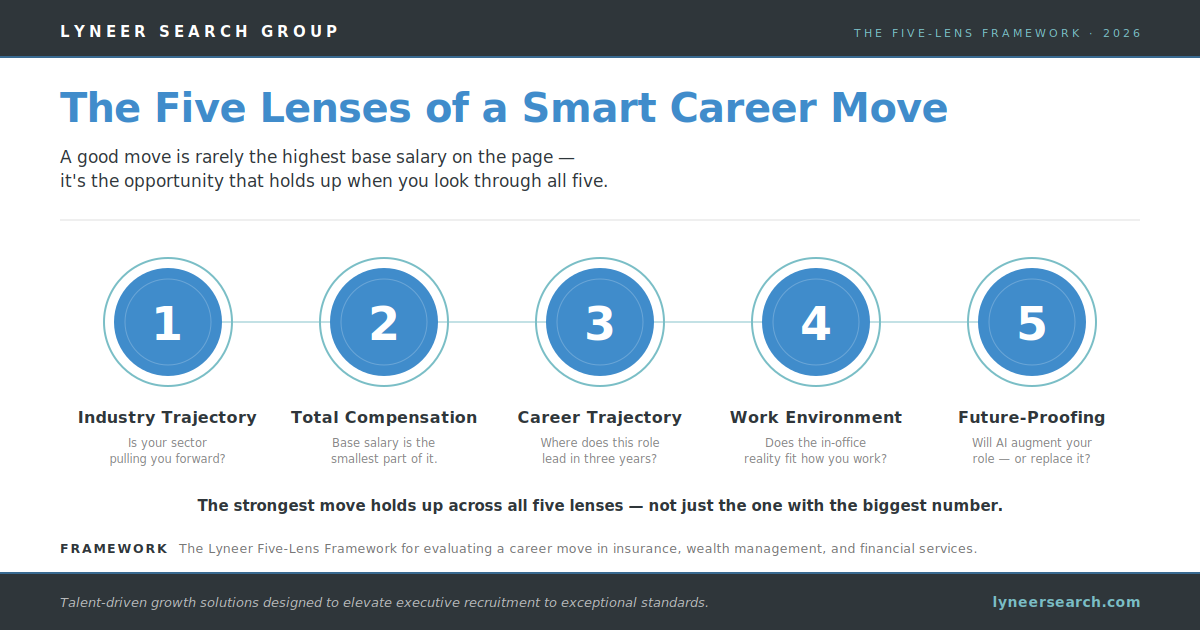
Base salary is rarely the right call. The five lenses that actually determine a good career move in insurance, wealth management, and financial services.
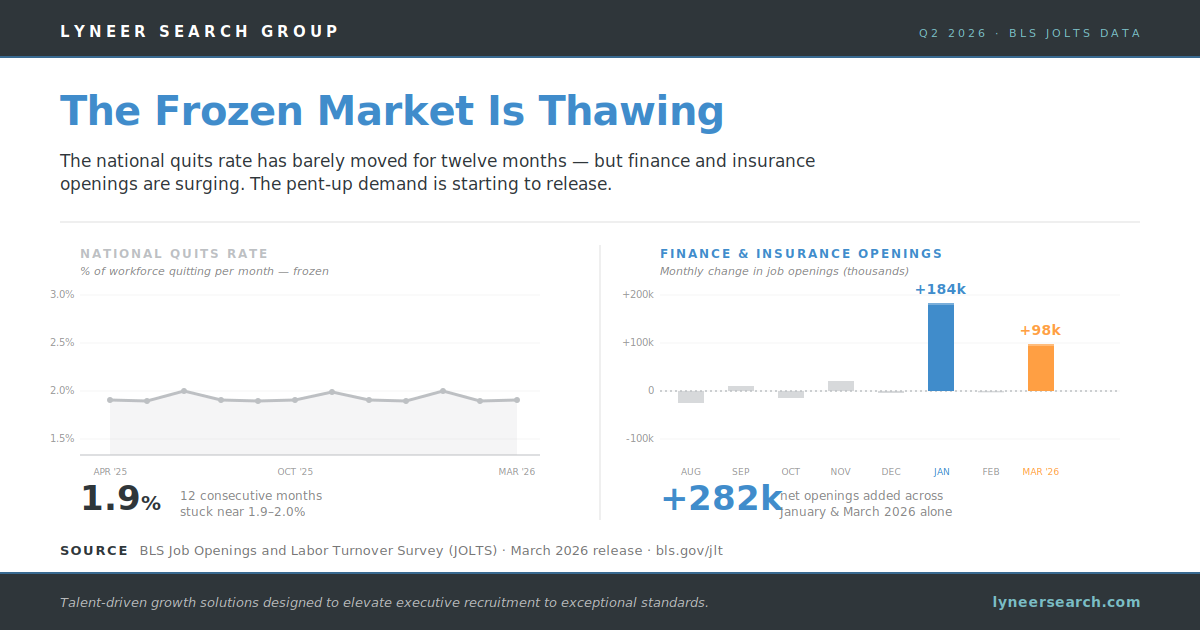
After two-plus years frozen, the job market is thawing. Finance & insurance openings are surging — here's what it means for candidates and hiring managers.

If you lead a wealth management practice, you have likely spent the last year hearing some version of the same message: hiring experienced advisors and planners has never been harder. Talent is scarce, competition is fierce, and the candidates you want are not looking.

If you lead talent strategy at an insurance carrier, you are navigating one of the most deceptive hiring markets in recent memory.

International Women's Day 2026 them Give to Gain is a springboard for leadership among industry leaders. Lyneer Search Group Celebrate's their voices and highlights their impact.