




The Strategic Hire: Insurance Executive Hiring in Q2 2026
June 1, 2026
Hiring Insights Q2 2026
May 2026 update
- The U.S. economy added 115,000 jobs in April 2026 and unemployment held at 4.3%, but unemployment in the insurance carriers sector sits at just 1.4%.
- Job openings in finance and insurance hit a decade low in December 2025, falling from an annual average of 281,000 to roughly 138,000 in a single month.
- P/C industry headcount grew only 0.81% over the trailing twelve months — well below the 1.42% carriers had targeted.
- 43% of carriers plan to maintain current staff levels in 2026 — a 15-year high — while voluntary turnover has dropped to 5.4% over the trailing six months.
- For the fifth consecutive Jacobson Group and Aon study, the hardest roles to fill remain Actuarial, Executive Leadership, and Analytics andData Science.
If you lead talent strategy at an insurance carrier in May 2026, the headlines are telling you one story and your open requisitions are telling you another.
The April jobs report from the Bureau of Labor Statistics showed the U.S.economy adding 115,000 jobs with unemployment steady at 4.3 percent— a labor market that the Chicago Fed president recently described as“stable without being good.” February’s initial print of -92,000 jobs has since been revised to a loss of 156,000, reinforcing the broader cooling story.
But inside the insurance industry, unemployment sits at 1.4 percent. Job openings in finance and insurance just hit a decade low. And carriers that planned to grow their teams achieved only 0.81 percent P/C headcount growth over the last twelve months — well below the 1.42 percent they targeted.
You are not imagining the gap between what the economy is doing and what your search is doing. The data confirms it.
The 43 Percent Signal
The Q1 2026 U.S. Insurance Labor Market Study, conducted by TheJacobson Group and Aon’s Strategy and Technology Group, delivered one of the most telling data points of the year: 43 percent of insurance carriers plan to maintain their current staff levels over the next 12 months. That is a 15-year high — up 10 percentage points from the prior survey just six months earlier.
At first glance, this looks like the industry hitting the brakes. It is not. It is the industry shifting gears.
After the aggressive hiring cycles of 2021 through 2023, carriers have moved into a phase we describe as selective stability. Companies are not shrinking — only 7 percent expect to reduce headcount this year, down 7points from July. Instead, they are hiring with surgical precision, filling roles that carry genuine strategic weight while doubling down on retention.
The retention data confirms it. Voluntary turnover across the insurance industry now sits at 5.4 percent over the trailing six months, compared to an 8.1 percent twelve-month average. Employees are staying put. And from a hiring manager’s perspective, that means the candidates you need are facing the same dynamic as their current employers — they are being retained more aggressively than at any point in the past decade.
The era of volume hiring in insurance is over. What has replaced it is a market where every open requisition matters more than it did two years ago.
The Gap That Defines This Market
Here is where most hiring strategies go wrong in 2026: they confuse where the demand is with where the difficulty is.
The Q1 study identifies three functional areas with the highest planned hiring volume:
- Technology — driven by AI, cloud migration, and legacy system modernization
- Claims — driven by complexity and catastrophic event response
- Underwriting — concentrated in specialty and excess-and-surpluslines
These represent the volume story. They are the roles where you will see the most job postings across the industry.
But the study also identifies a separate, equally important list — the roles that are most difficult to fill. For the fifth consecutive survey, the same three categories lead:
- Actuarial
- Executive Leadership
- Analytics and Data Science
This distinction matters enormously for your hiring strategy. If you are staffing a technology team, you are competing for candidates in a crowded but accessible talent pool. Standard recruiting methods can work, though you will need to move quickly.
If you are trying to replace a retiring Chief Actuary, fill a VP of Analytics role, or recruit a C-suite leader with deep P&C expertise, you are operating in a fundamentally different market. These candidates are not responding to job postings. They are not on LinkedIn with “Open to Work”badges.
They are embedded in organizations where they are valued,compensated well, and often unaware that a better-fit opportunity exists.
The specialty and E&S underwriting market presents a similar dynamic.While underwriting overall sits on the “high volume” list, the senior practitioners with the broker relationships, the niche risk expertise, and the authority to make complex placement decisions are not interchangeable with the broader underwriting talent pool. They are scarce, embedded, and increasingly expensive to recruit.
The Retirement Reality Is Now
The talent scarcity in senior roles is not a temporary market fluctuation. It is structural — and it is happening now, not on some future horizon.
The widely reported projection that approximately 400,000 insurance professionals would retire by 2026 — derived from Bureau of LaborStatistics workforce data and cited by RSM, Insurance Business Magazine,and MarshBerry — is no longer a forecast. It is the present operating environment.
The demographic picture makes the challenge clear. Approximately 1.37million insurance professionals are aged 55 or older, while only 214,000 are between 20 and 24. That is a six-to-one ratio of retirement-age employees to early-career entrants. The imbalance is particularly severe in roles that require decades of accumulated judgment — actuarial science, executive leadership, and complex underwriting.
When a 25-year veteran underwriter leaves, the organization does not just lose a filled seat. It loses a network of broker relationships, an intuitive understanding of risk patterns, and institutional memory that a moonboarding program can replicate. And in a market where 43 percent ofcarriers are focused on retention, the professionals who could replace veterans are being held more tightly by their current employers than at any time in recent memory.
If you have a critical senior insurance search pending in 2026, the cost of waiting is no longer measured in weeks. It is measured in market share.
Schedule a confidential search consultation
AI Is Raising the Bar, Not Lowering It
One factor that many hiring managers underestimate is the role of artificial intelligence in reshaping — not reducing — senior talent demand.
AI is contributing to the maintenance trend, as carriers pause certain hiring plans to evaluate how AI will improve specific functions. Roles in financial reporting, data synthesis, call centers, and transactional operations face the greatest displacement risk. The information services sector has lost 342,000 jobs since November 2022, a decline directly tied to AI adoption.
But here is what this means for your hiring strategy: as AI absorbs routine work, the value of experienced human judgment rises.
- The actuary who can interpret model outputs and explain risk to the board.
- The analytics leader who understands not just the data but the underwriting philosophy behind it.
- The claims executive who can lead AI-augmented adjudication while maintaining regulatory compliance and customer trust.
- The C-suite leader who can drive AI transformation across an organization while protecting institutional knowledge.
AI is not eliminating the need for senior insurance talent. It is elevating the requirements. And that makes your hardest-to-fill roles even harder.
What to Do About It
If your remaining 2026 hiring plan includes any role on the “hardest to fill”list — actuarial, executive leadership, analytics — or any senior position replacing a retiring leader, standard recruiting approaches are unlikely to deliver results on the timeline you need.
The candidates who can fill these seats are passive. They are performing well. They are being retained. Reaching them requires a confidential,relationship-driven approach built on years of trust within the insurance industry.
This is the work that Lyneer Search Group has done exclusively for more than 25 years, with a 100 percent placement rate in retained searches since 1993 and recognition in HuntScanlon Media’s 2025 Select Guide to America’s Top 250 Executive Search Firms.
If you are facing a critical hire in the second half of 2026, we welcome the opportunity to discuss your specific situation. Our search consultants bring deep insurance industry relationships and can provide a confidential, no-obligation assessment of your talent landscape. Fill out the form below to schedule your conversation.

How to hire a statutory accounting leader who can run an NAIC-ready close. Role calibration, interview framework, comp benchmarks, and red flags to screen out.

CIO total compensation hit $1.82M. Three new roles emerged. Discover what's driving compensation growth across family offices and MFOs in 2026 — and download the full benchmark guide.
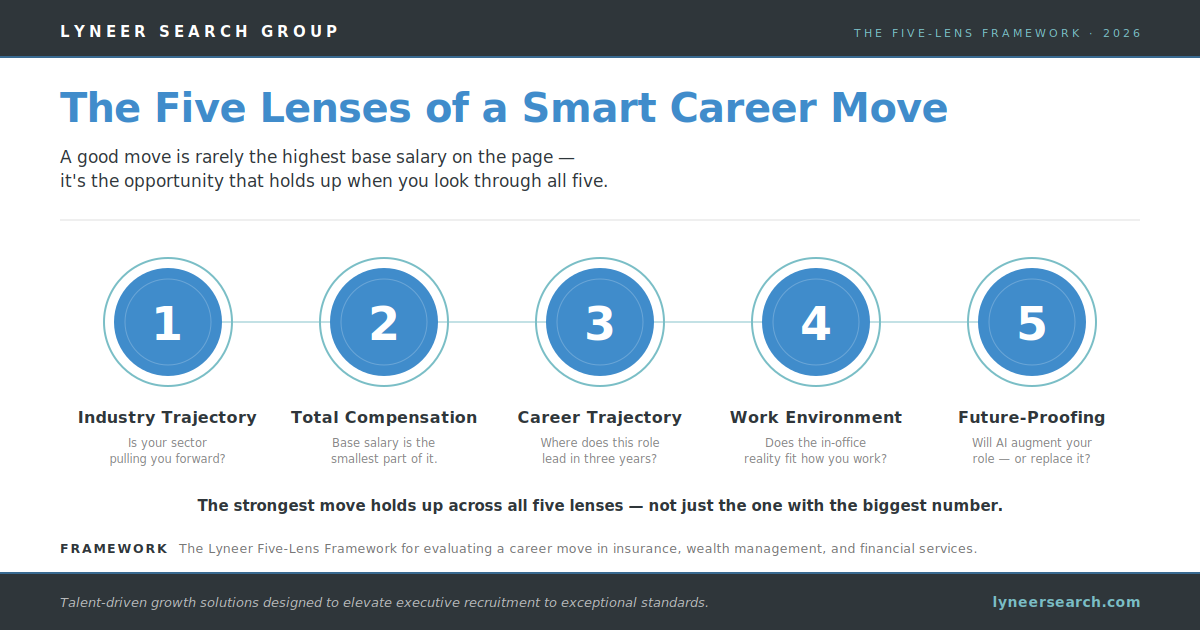
Base salary is rarely the right call. The five lenses that actually determine a good career move in insurance, wealth management, and financial services.
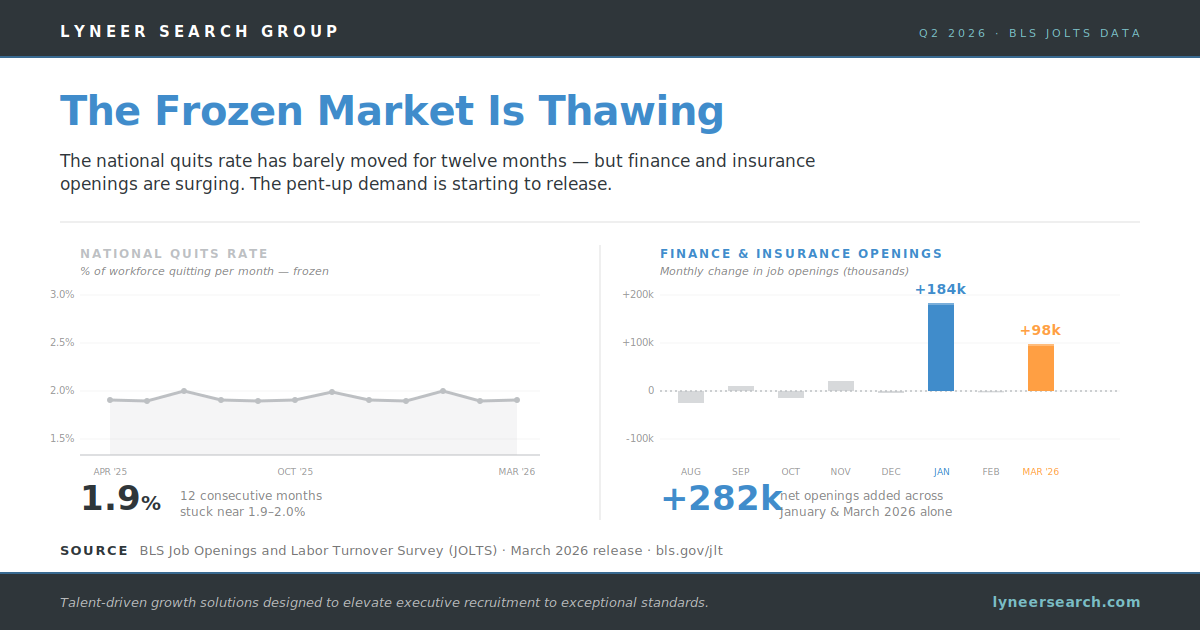
After two-plus years frozen, the job market is thawing. Finance & insurance openings are surging — here's what it means for candidates and hiring managers.

The insurance industry is losing 400,000 workers while five new roles emerge. Specialty underwriters earn 25–50% more than generalists. Download Lyneer's 2026 Insurance Salary Guide covering 80+ roles across carriers, brokers, and MGAs.

If you lead a wealth management practice, you have likely spent the last year hearing some version of the same message: hiring experienced advisors and planners has never been harder. Talent is scarce, competition is fierce, and the candidates you want are not looking.

If you lead talent strategy at an insurance carrier, you are navigating one of the most deceptive hiring markets in recent memory.

International Women's Day 2026 them Give to Gain is a springboard for leadership among industry leaders. Lyneer Search Group Celebrate's their voices and highlights their impact.

Discover how the insurance, wealth management, MFO/ UHNW, financial services industries are evolving as 2026 is changing the game. Gain expert hiring tips and industry insights to navigate 2026 with confidence.

Discover why working with Lyneer Search Group helps middle market insurers expand faster and smarter—accessing top executive talent, reducing risk, and saving time.