




How to Evaluate a Job Offer in 2026: The Five Lenses That Actually Matter
Karen Childers • May 20, 2026
Don't make the mistake of only considering base salary when thinking about a career move. There are five lenses that determine a smart one.
Key Takeaways
- Base salary should rarely be the deciding factor between two reasonable offers in finance, insurance, or wealth management.
- The five lenses that determine a good move: industry trajectory, total compensation, career arc, work environment, and future-proofing.
- Total compensation (bonus, equity, 401(k) match, deferred comp, benefits) often accounts for a larger share of the real economic gap between two offers than headline base salary.
- 90% of Lyneer placements earn promotions within their organizations. That's a measure of fit.
- AI is reshaping finance and accounting work, but the BLS still projects 5% job growth for accountants and auditors through 2034.
Candidates who treat their next move as a base-salary math problem usually leave real money behind. The smarter approach, and the one Lyneer has built its practice around, is to evaluate every opportunity through five lenses. Here's the framework, and how to apply it.
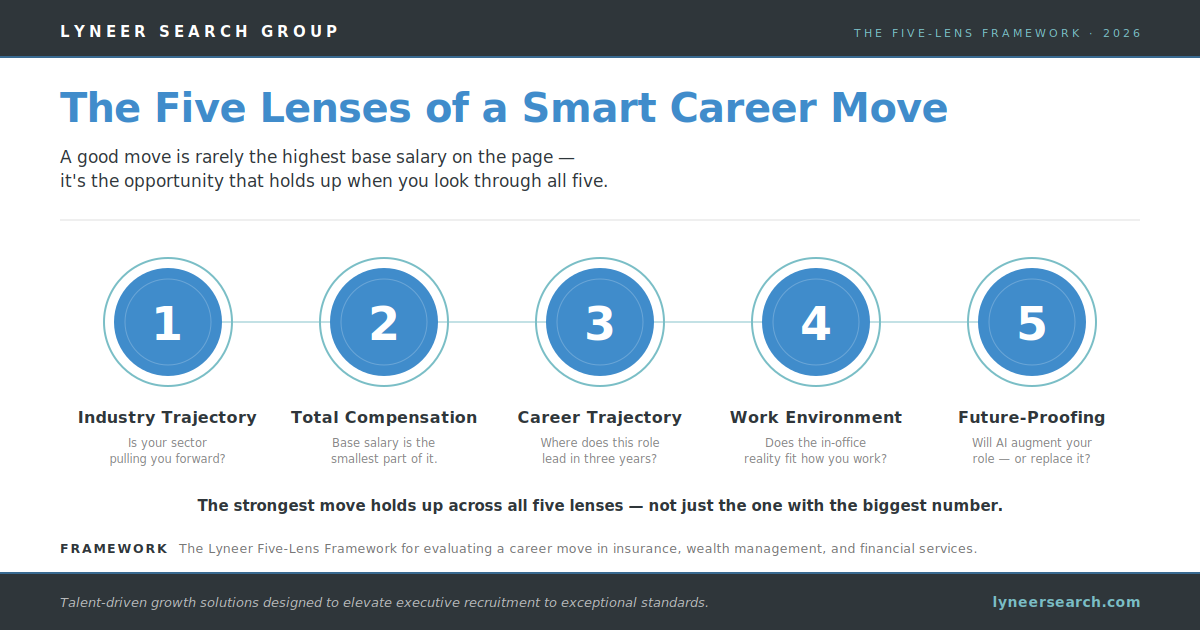
Lens 1: Industry trajectory, is your sector pulling you forward?
This is the lens most candidates skip, and the one Lyneer leads every conversation with. The insurance industry is in the middle of a generational handoff: the Bureau of Labor Statistics and the National Association of Mutual Insurance Companies both project that roughly 400,000 insurance professionals will retire in the U.S. by the end of 2026, with about half the current workforce expected to retire within the decade.
Wealth management faces a parallel dynamic. McKinsey projects a shortfall of roughly 100,000 financial advisors by 2034 at current productivity levels, with advisor headcount having grown just 0.2% over the past decade.
What this means at the candidate level: in our industries, experienced specialists (chief underwriting officers, controllers, fiduciary officers, senior planners, actuaries, COOs) are negotiating from a structurally stronger position than broad wage averages suggest. Industry-specific demand is the tailwind a national number can't capture.
For the current data on how that demand is accelerating, see our companion piece, The Frozen Job Market Is Thawing.
Lens 2: Total compensation, the base number is the smallest part
Bonuses, equity, deferred compensation, 401(k) match, profit-sharing, expanded healthcare, parental leave, and tuition reimbursement routinely add tens of thousands of dollars in annual value to a senior finance or insurance offer, sometimes more than the base salary differential between two competing positions.
Consider a senior financial analyst we recently advised through two offers at competing wealth platforms. The first carried a base salary $7,000 higher than the second. The second included a meaningful equity stake, a 7% 401(k) match (versus 3%), and a defined two-year path to a director-level role. Modeled across a five-year horizon, the lower-base offer produced higher total compensation and a faster career arc.
Lens 3: Career trajectory, where does this role lead in three years?
A corporate accountant we worked with last year accepted a controller role at a regional insurance carrier, at the same base they'd been earning. Their reasoning: the new firm had a defined succession plan mapping them into a VP Finance seat within 36 months. Eighteen months in, they're on track. The salary trade-off they didn't take has been more than recovered.
This is the calculus our results bear out. Ninety percent of Lyneer placements earn promotions within their organizations. That number comes from how carefully we evaluate fit during the search. A good move is measured by where it leads.
Lens 4: Work environment, the return-to-office picture has hardened
The return-to-office picture across financial services has clarified. Per BLS Q1 2026 telework data, finance and insurance remain the second-highest remote-adoption sector in the U.S. economy, behind only technology. But the trajectory is unmistakable: several major carriers, banks, and asset managers have moved to four or five days in-office for 2026, and the share of fully remote job postings continues to compress.
For candidates, hybrid is the realistic floor for most senior finance and insurance roles now. Remote-by-default is mostly gone. And the candidates who arrive at interviews with a clear, professional view on in-office presence are standing out to hiring managers.
The return-to-office picture across financial services has clarified. Per BLS Q1 2026 telework data, finance and insurance remain the second-highest remote-adoption sector in the U.S. economy, behind only technology. But the trajectory is unmistakable: several major carriers, banks, and asset managers have moved to four or five days in-office for 2026, and the share of fully remote job postings continues to compress.
For candidates, hybrid is now the realistic floor for most senior finance and insurance roles — not "remote by default." And the candidates who arrive at interviews with a clear, professional view on in-office presence are standing out to hiring managers.
Lens 5: Future-proofing, how AI is changing the work
The accounting and finance roles in our industries are changing fast. The popular narrative gets the direction wrong. The BLS projects 5% growth for accountants and auditors through 2034, with roughly 124,200 annual openings. Gartner has estimated that fewer than 10% of finance functions will see headcount reduction by 2026.
What's changing is the work itself. Rules-based tasks like transaction categorization, basic reconciliation, and invoice processing are getting absorbed by automation. Judgment-based work is getting more valuable: forensic accounting, complex tax planning, CFO-level strategy, M&A diligence, fiduciary oversight.
For candidates, the question to ask is: does this next role move me toward the work AI augments, or toward the work AI is replacing?
Putting the five lenses together
Applied together, the five lenses produce a different conversation than the one most candidates walk into. The questions that lead to better outcomes go beyond "what's the base?":
- How is this organization positioned within its sector over the next three years?
- What does the full economic offer look like across base, bonus, equity, benefits, and retirement?
- What is the realistic path from this role to the next one, and how have prior people in this seat moved?
- What is the in-office expectation, and is it a fit for how I work best?
- Will this role keep me valuable as AI continues to reshape our industries?
Lyneer's Executive Search Strategy™ evaluates fit across four dimensions: technical skill, leadership capability, cultural alignment, and long-term growth potential. The five lenses are the candidate-side version of that same discipline: a way to tell whether a move is a real step forward or just a sideways one with a bigger number on it.
Evaluating an Offer? Let's Talk.
A good career move is rarely the highest base salary on the page. It's the opportunity that holds up across all five lenses. Lyneer's senior consultants help candidates weigh every dimension of a move, and help hiring managers build offers that compete on more than salary.
Frequently Asked Questions
How much should base salary actually weigh in my decision?
In our experience advising senior candidates in finance, insurance, and wealth management, base salary should rarely be the deciding factor between two reasonable offers. Total compensation — bonus, equity, 401(k) match, deferred comp, benefits — typically accounts for a larger share of the real economic difference. Career trajectory and industry fit often outweigh both.
How do I evaluate two competing job offers?
Compare them across five lenses rather than on base salary alone: industry trajectory (which sector and firm is better positioned over three years), total compensation (the full economic package, not just base), career arc (where each role realistically leads), work environment (in-office expectations and fit), and future-proofing (whether the role keeps you valuable as AI reshapes the work). The stronger offer is the one that holds up across all five.
Will AI replace finance and accounting roles?
The BLS projects 5% growth for accountants and auditors through 2034, with roughly 124,200 annual openings. AI is changing the work. It automates rules-based tasks and makes judgment-based, advisory, and oversight roles more valuable. The strongest career positioning is in work that combines technical depth with advisory capability.
What is Lyneer's role in evaluating a job offer?
Lyneer Search Group works exclusively in insurance, wealth management, and financial services. Our consultants help candidates evaluate offers across all five lenses — industry trajectory, total compensation, career arc, work environment, and future-proofing — using the Lyneer Executive Search Strategy™. We have maintained a 100% placement rate on retained searches since 1993, and 90% of our placements earn promotions within their organizations.
Who we are
Lyneer Search Group is the specialist executive search firm serving the insurance, wealth management, and financial services industries. We place senior leaders across finance,
accounting,
underwriting,
actuarial, operations, compliance, and HR. 100% placement rate on retained searches since 1993. HuntScanlon 2025 Top 250.

How to hire a statutory accounting leader who can run an NAIC-ready close. Role calibration, interview framework, comp benchmarks, and red flags to screen out.

Insurance unemployment is 1.4% and 43% of carriers are holding headcount. Here's why your toughest Q2 2026 hires need more than standard recruiting.

CIO total compensation hit $1.82M. Three new roles emerged. Discover what's driving compensation growth across family offices and MFOs in 2026 — and download the full benchmark guide.
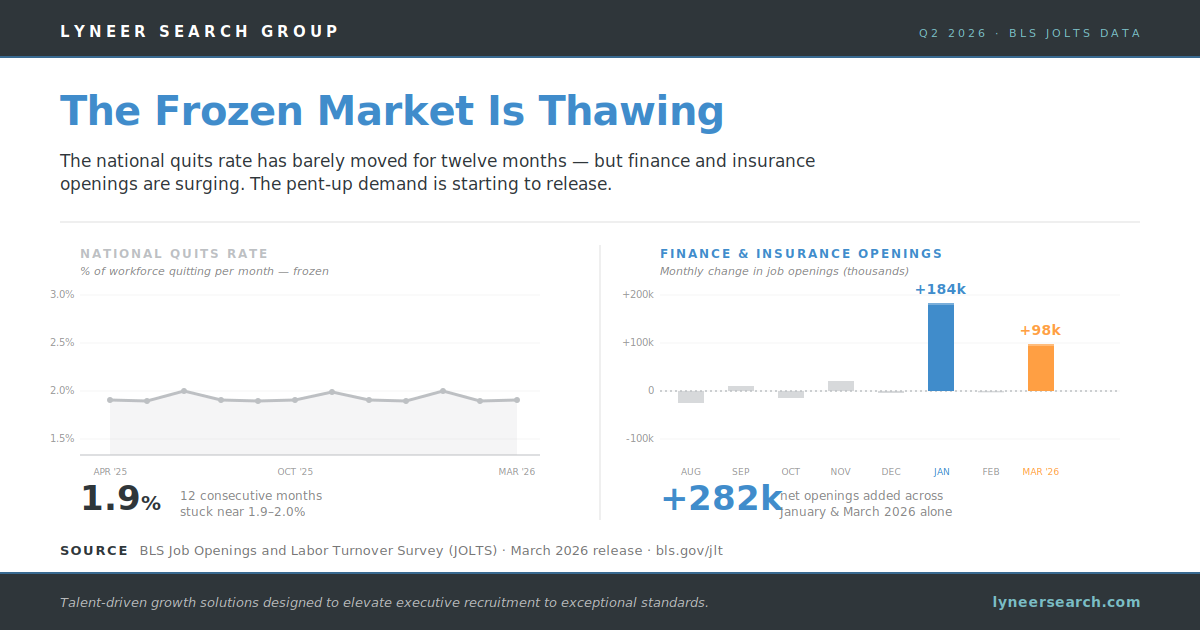
After two-plus years frozen, the job market is thawing. Finance & insurance openings are surging — here's what it means for candidates and hiring managers.

The insurance industry is losing 400,000 workers while five new roles emerge. Specialty underwriters earn 25–50% more than generalists. Download Lyneer's 2026 Insurance Salary Guide covering 80+ roles across carriers, brokers, and MGAs.

If you lead a wealth management practice, you have likely spent the last year hearing some version of the same message: hiring experienced advisors and planners has never been harder. Talent is scarce, competition is fierce, and the candidates you want are not looking.

If you lead talent strategy at an insurance carrier, you are navigating one of the most deceptive hiring markets in recent memory.

International Women's Day 2026 them Give to Gain is a springboard for leadership among industry leaders. Lyneer Search Group Celebrate's their voices and highlights their impact.

Discover how the insurance, wealth management, MFO/ UHNW, financial services industries are evolving as 2026 is changing the game. Gain expert hiring tips and industry insights to navigate 2026 with confidence.

Discover why working with Lyneer Search Group helps middle market insurers expand faster and smarter—accessing top executive talent, reducing risk, and saving time.